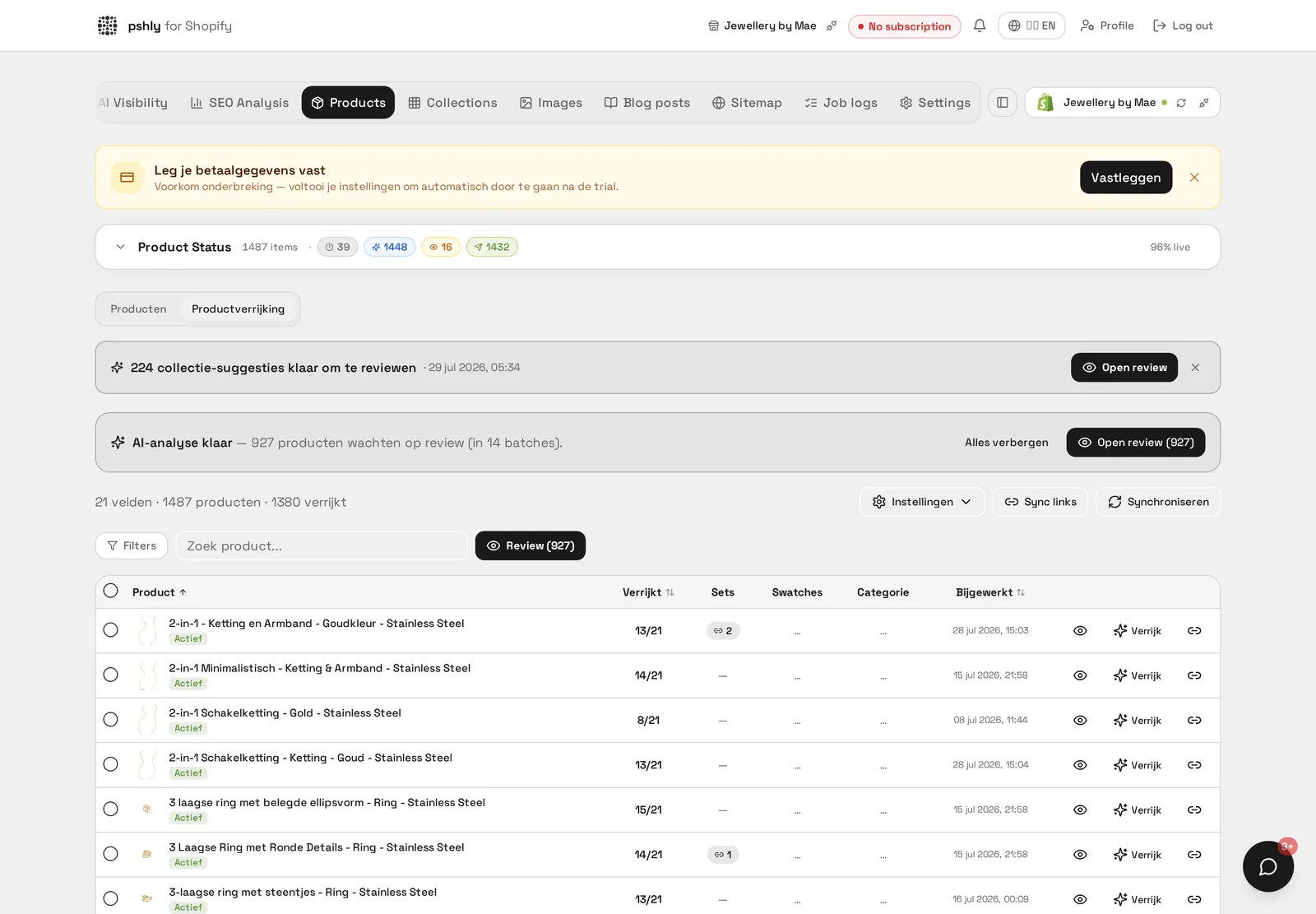
Manually writing product descriptions, collection pages, and blog posts costs Shopify merchants an average of 8-12 hours per week. That's time better spent on strategy, sourcing, or customer service. In this article, we explore how AI-powered content tools are fundamentally changing this equation.
Why traditional content management no longer works
With hundreds or even thousands of products in your catalog, it's impossible to manually optimize every page. Supplier copy isn't unique, and generic text ranks poorly in search engines. The result: missed opportunities and lower rankings.
Adding to the challenge, Google has become increasingly sophisticated at identifying 'thin content' — pages with little added value. A product page with just a title and two specifications simply won't be indexed for competitive search terms anymore.
The evolution of AI in e-commerce content
The first generation of AI writing tools produced generic text without context. The current generation is fundamentally different: it understands your product data, analyzes your market, and writes in your brand voice.
The key lies in contextual intelligence: AI that knows not just what you sell, but who your customers are, which search terms they use, and how your competitors structure their content. This is the difference between a tool that generates text and a platform that drives your content strategy.
The solution: AI that understands your data
Modern AI tools analyze not just your products, but also your Google Search Console data. This means descriptions are written based on what customers actually search for — not guesswork.
A smart platform generates content in your tone of voice, with the right keywords, internal links, and SEO metadata. Best of all: everything is pushed directly to your Shopify store without copy-paste work.
Five pillars of AI-powered content management
Effective AI content management rests on five pillars:
- Data integration — Connection with Google Search Console, product data, and competitive analysis
- Contextual generation — AI that understands your brand identity, target audience, and product category
- Multi-format output — From product descriptions to collection pages and blog posts
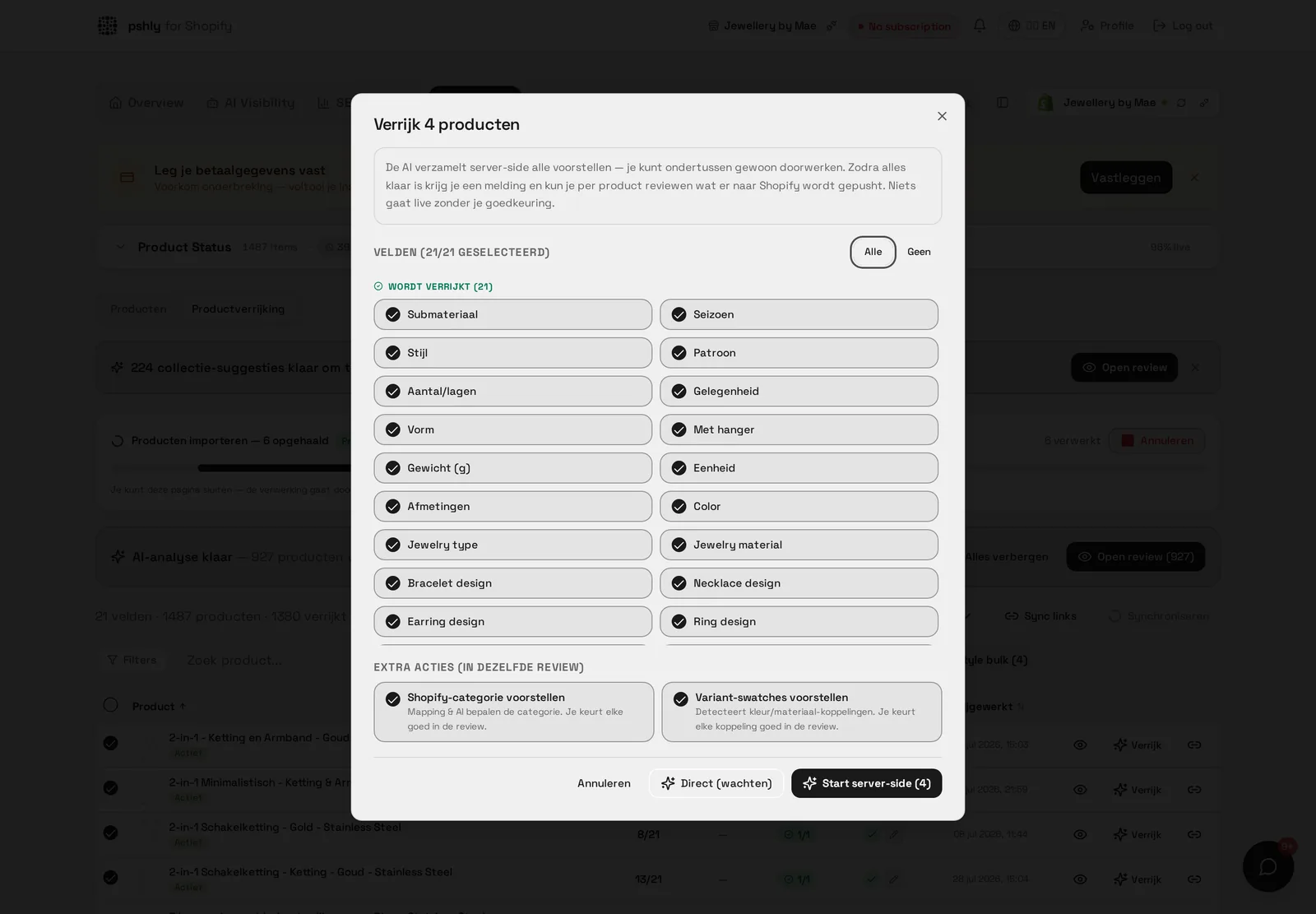
- Quality assurance — Review workflows, A/B variants, and comprehensive SEO analysis per page
- Direct publishing — Push to Shopify without developer involvement
The role of Search Console data in AI content
What traditional AI tools miss is the feedback loop with real search data. By integrating Google Search Console, the AI knows exactly:
- Which search terms drive traffic for similar products
- Which content gaps exist in your assortment
- Which pages are declining in ranking and need an update
- How long visitors stay on your pages (engagement signals)
This data is injected into the AI prompts, ensuring every generated text is optimized for the search terms that actually matter.
Internal links: the forgotten growth lever
An underappreciated aspect of content management is internal link structure. AI platforms analyze your entire product catalog and suggest relevant internal links — from products to collections, from blog posts to products. This strengthens not only your SEO but also improves user experience and average order value.
AI Visibility: the next frontier
With the rise of AI-powered search engines like ChatGPT, Perplexity, and Google AI Overviews, AI Visibility is becoming increasingly important. Content that ranks well in traditional search engines doesn't automatically perform well in AI search environments. Structured data, FAQ sections, and in-depth, unique content play a much larger role.
What are the concrete results?
- Up to 80% time savings on content creation
- Higher rankings through unique, optimized copy
- Better conversion through persuasive product pages
- Consistent brand voice across all pages
- Less dependency on freelancers and agencies
- Faster time-to-market for new products
Common mistakes with AI content
AI content is not a magic bullet. The most common mistakes we see:
- No review process — Always check AI content before it goes live
- No brand voice configuration — Without clear instructions, AI generates generic text
- Ignoring data — Writing content without Search Console insights is shooting in the dark
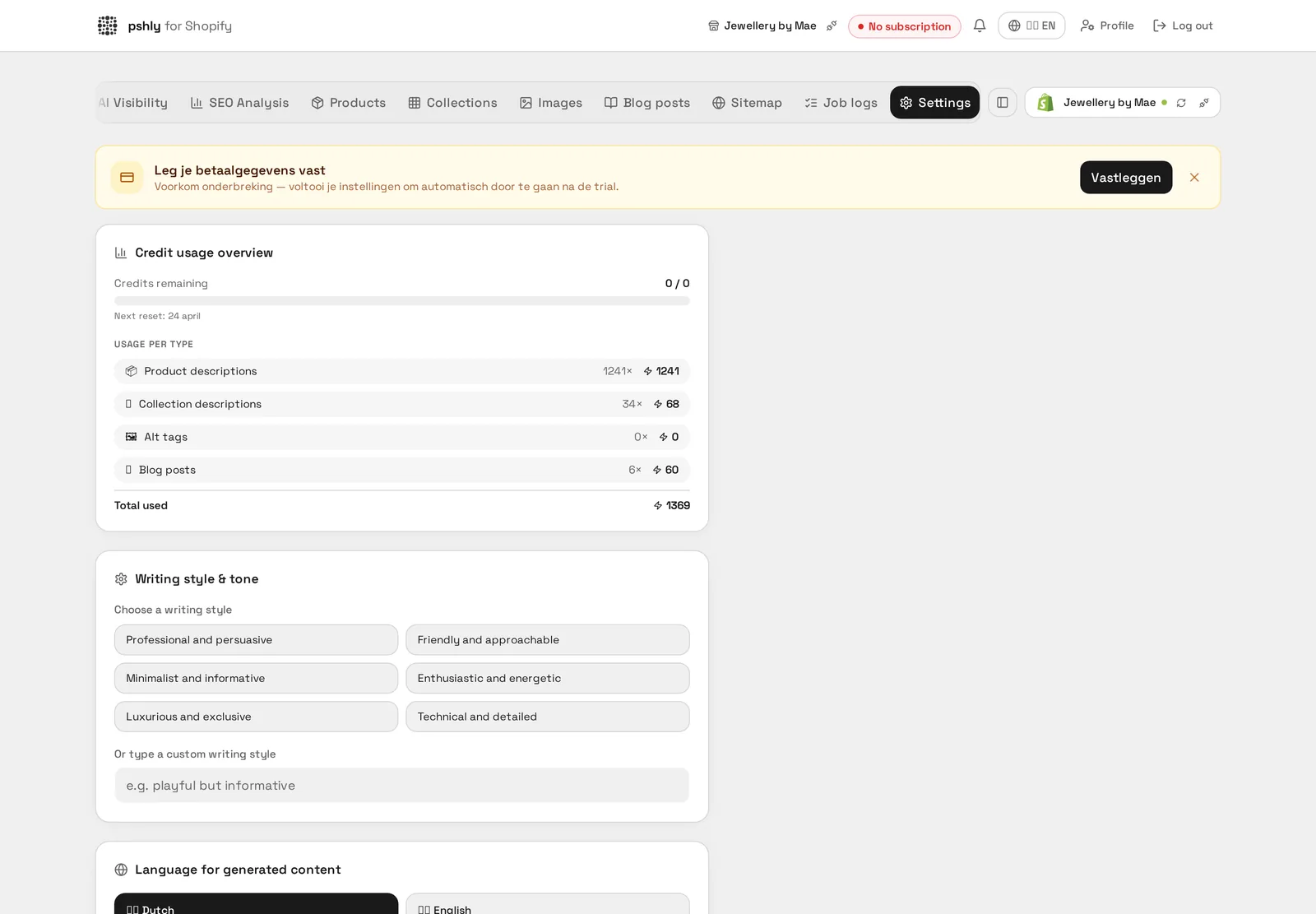
- Forgetting alt tags — Image alt tags are a quick win that's often skipped
Get started
Want to see how AI content management works for your Shopify store? Start free or book a free demo with our team. In 30 minutes, we'll show you how to produce more content in less time — without compromising on quality.