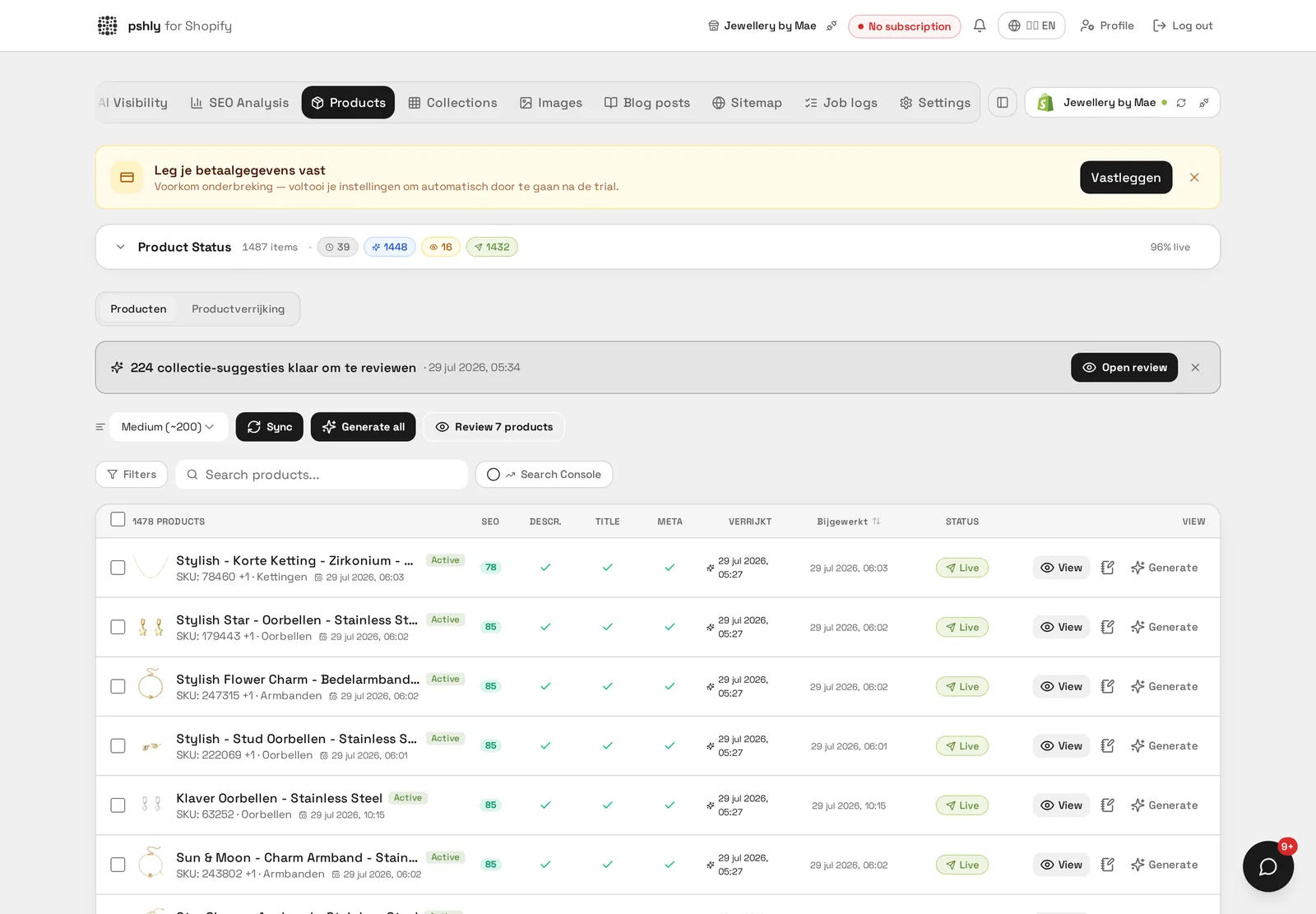
A great product description does two things at once: it convinces visitors to buy and helps Google understand what your page is about. Yet product descriptions are often treated as an afterthought. In this comprehensive guide, we share everything you need to know.
Why product descriptions truly matter
Research by Salsify shows that 87% of consumers consider product content an important factor in purchase decisions. Yet more than half of all Shopify stores have standard supplier text on their product pages — or worse, no description at all.
The impact on your business is directly measurable:
- Product pages with unique descriptions convert on average 30% better
- Optimized product pages rank for 2-3x more search terms
- Longer, informative descriptions reduce return rates
The ideal product description structure
An effective product description contains at least these elements:
- A compelling opening sentence that states the core benefit — not the feature, but the benefit to the customer
- A short paragraph positioning the product in the customer's life
- Features and specifications in a clear list
- Use cases that help customers envision themselves using the product
- Social proof (reviews, certifications, awards)
- A clear call-to-action
The psychology behind persuasive product copy
The best product descriptions speak to both the rational and emotional brain:
Emotional: Help the customer imagine how the product improves their life. "Imagine waking up in this breathable cotton bedding..." works better than "100% cotton, 200 thread count."
Rational: Support the emotional trigger with concrete specifications, comparisons, and guarantees. The customer wants confirmation that their emotional choice is also rationally sound.
Urgency: Without being pushy, you can use scarcity or timing: seasonal products, limited editions, or "most popular choice" labels.
SEO optimization for product pages
Use your primary keyword in the title, the first paragraph, and at least one subheading. Write a unique meta description of up to 160 characters. Don't forget your image alt tags either — they contribute to your image search traffic.
Specific SEO guidelines for Shopify product pages:
- Title tag — Maximum 60 characters, primary keyword at the front
- Meta description — Maximum 160 characters, unique per product, with call-to-action
- H1 — One per page, matches the product title
- H2/H3 subheadings — Minimum 2-3 per page with relevant search terms
- Internal links — Link to related products and relevant collection pages
- Structured data — Product Schema.org markup with price, availability, and reviews
The power of product variants in your content
Many Shopify stores ignore their product variants in the description. But variants (colors, sizes, materials) are often exactly the search terms customers use. "Blue leather handbag" is a much more specific and conversion-focused search term than "handbag."
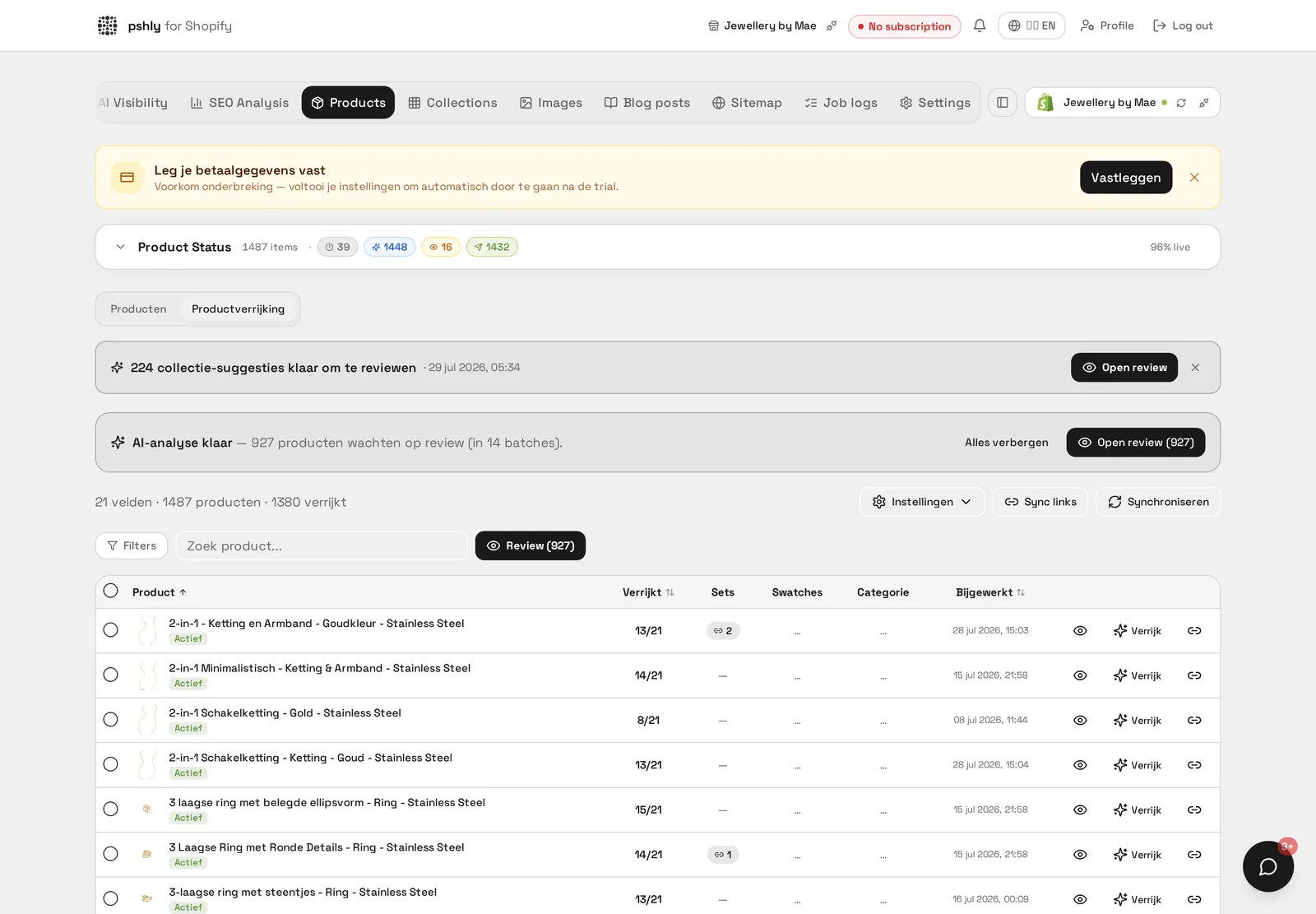
A smart content platform automatically integrates variant information into the generated description, letting you rank for long-tail search terms that are traditionally missed.
Internal links in product descriptions
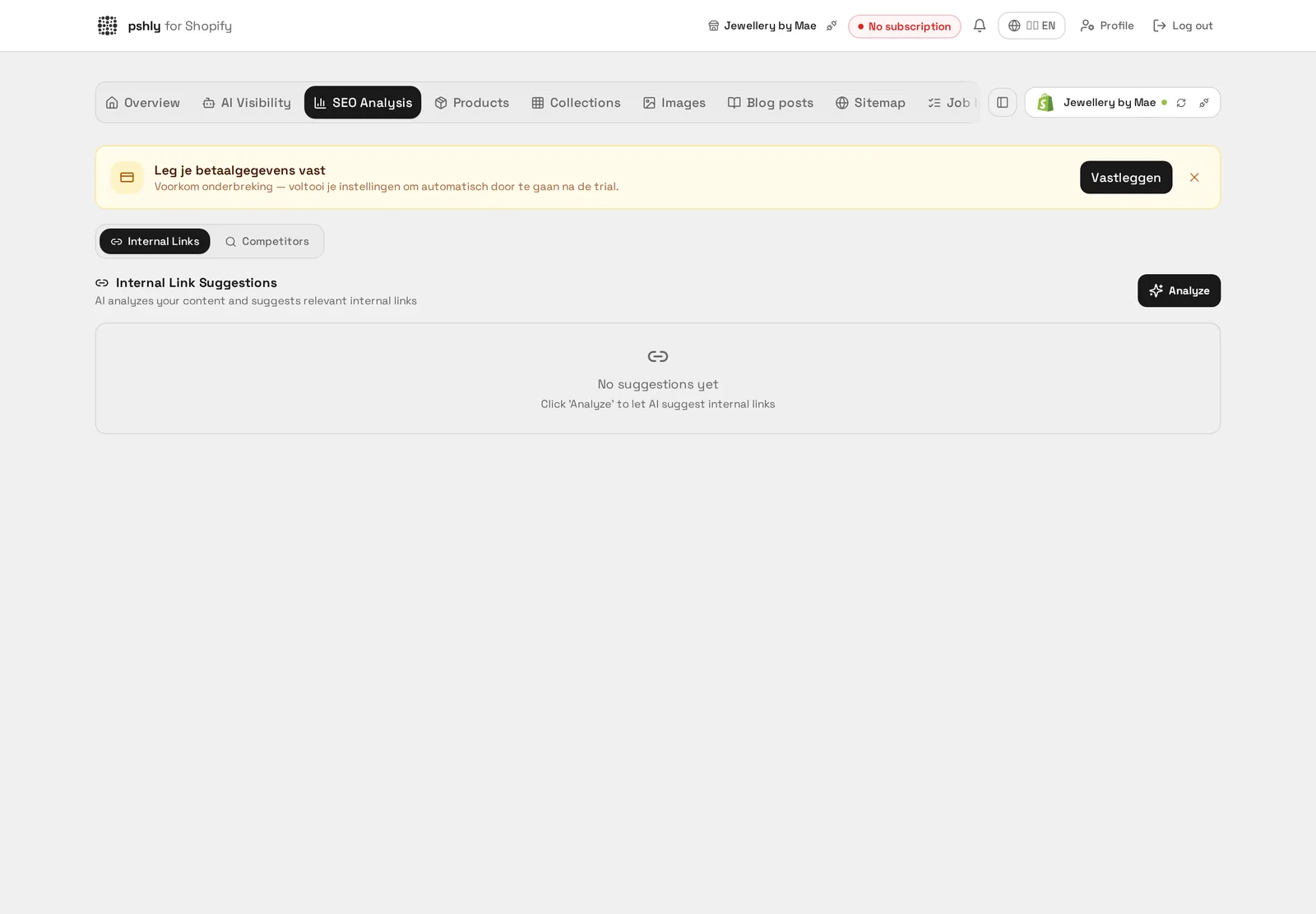
Internal links in your product descriptions serve three purposes:
- SEO: They help Google understand the relationship between your pages
- Conversion: They guide customers to related products (cross-selling)
- User experience: They help customers discover your assortment
Best practice is to include 2-4 relevant internal links per product description to related products and collections — but never to the product itself.
Common mistakes
The five biggest mistakes we see in Shopify stores:
- Using supplier copy — Google treats this as duplicate content and ranks these pages lower
- No internal links — Missed opportunity for both SEO and cross-selling
- Same generic text for similar products — Every product page deserves unique content
- Too-short descriptions — Google prefers informative, comprehensive content
- Keyword stuffing — Unnaturally cramming keywords has the opposite effect
A/B testing product descriptions
The best way to discover what works for your target audience is A/B testing. Generate two variants of the same product description — for example, an emotional versus a technical variant — and measure which converts better. Modern AI platforms offer this functionality built-in.
Automate with AI — without losing quality
With an AI content platform, you generate unique, optimized product descriptions in seconds. The AI analyzes your product variants, images, and search data to write copy that's truly relevant.
The difference from manual writing? Consistency and speed. Where a copywriter needs 20-30 minutes per product, AI generates an optimized description in seconds — with the same quality standard for every product.
Try it free and discover the difference. Or book a demo to see how it works for your store.