Documentation

    AI Visibility

    Improve how AI models find and cite your webshop.

    1Citability Score

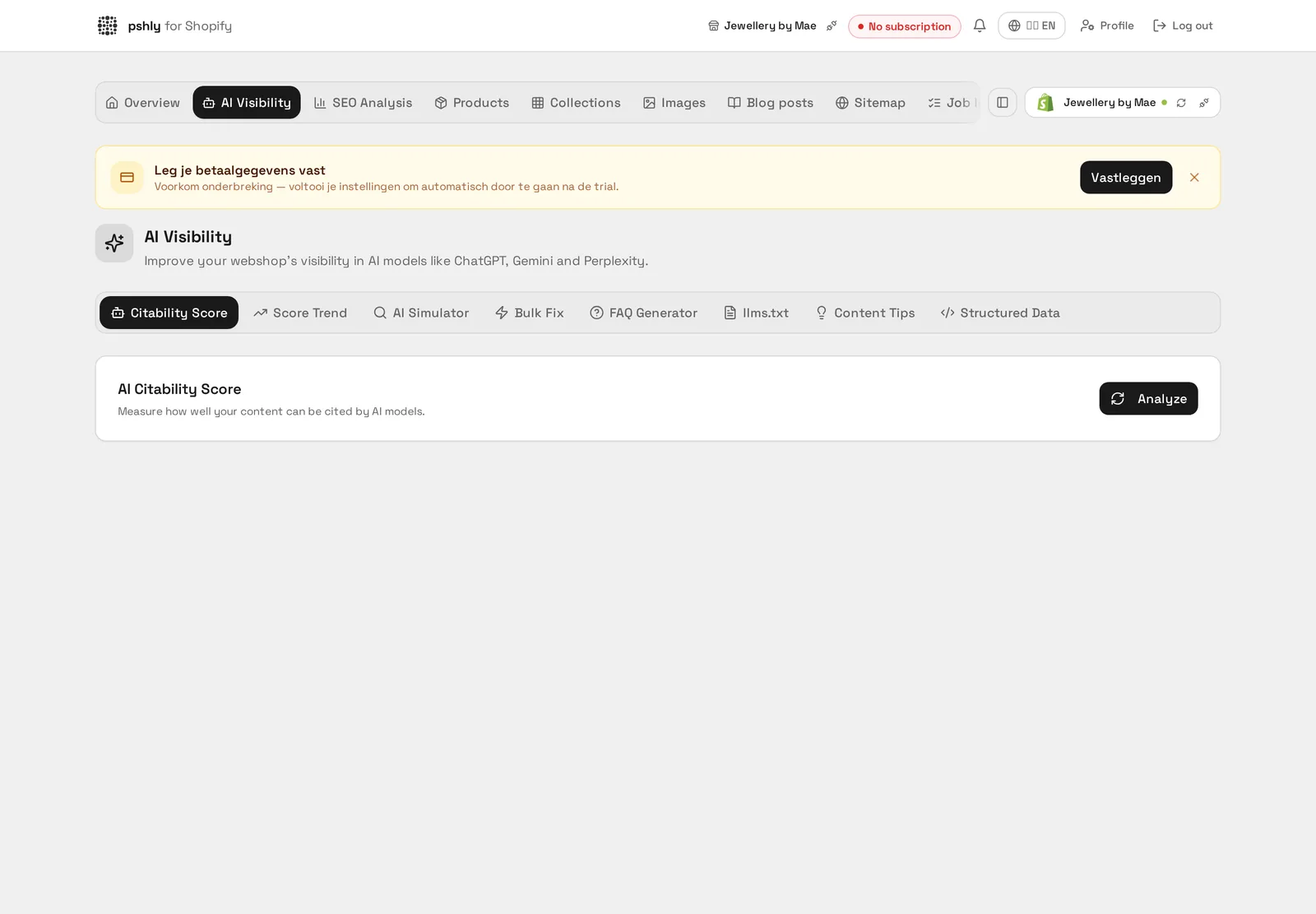
    The Citability Score measures how well your content can be cited by AI models like ChatGPT, Gemini and Perplexity.

    A higher score means AI systems will cite your store more often. Calculated per product and collection.
    Citability Score

    Real-world example

    Citability 31 → 69. Products without specifications and FAQ are rarely cited by ChatGPT or Google AI Overviews.

    After filling 18 specification fields (dimensions, flute type, load capacity), a FAQ block per product and Product schema, the citability score rose from an average of 31 to 69.
    2Score factors explained

    The score consists of:

    • Text length: Minimum 150 words
    • Factual density: Materials, dimensions, specifications
    • Entity clarity: Clear product and brand names
    • SEO metadata: Filled meta titles and descriptions
    • Structure: Headings, lists and paragraphs
    • Differentiation: Unique content

    Per factor you get a score and concrete tips.

    Score factors explained

    Real-world example

    A 90-word product page scored 42/100 for G&F Verpakkingen. After expanding it to 180 words with material (double wall), dimensions (40×30×20 cm) and use case, the score rose to 81/100.

    Factual density in particular — concrete specifications instead of generic language — proved to be the biggest lever for a higher score.


    3AI Search Simulator

    The AI Search Simulator simulates how an AI model would find your store for a search query.

    1. Enter a search query.
    2. The simulator checks if your content is cited.
    3. You get feedback on improvements.
    AI Search Simulator

    Real-world example

    Query "best shipping box for webshops" simulated for G&F Verpakkingen. The simulator showed that the collection page wasn't cited because dimensions were missing from the first paragraph.

    After adding concrete measurements and material choice, the page did surface as a source in the simulated AI search results.


    4FAQ Generator & Shopify push

    The FAQ Generator creates FAQs based on your product information.

    • Generated as JSON-LD structured data.
    • Improves visibility in Google and AI search engines.
    • Can be pushed directly to Shopify as script tags.

    Existing FAQ tags are automatically replaced on regeneration.

    FAQ Generator & Shopify push

    Real-world example

    "What size shipping box fits a 5 kg parcel?" For G&F Verpakkingen, the FAQ Generator automatically created these kinds of questions per product category, including JSON-LD structured data.

    These FAQs soon appeared as expandable results in Google, boosting the visibility of the shipping boxes collection.


    5llms.txt Generator

    The llms.txt file tells AI crawlers what content is available.

    • Automatically generated from your products and collections.
    • Contains an overview of your most important pages.
    • Helps AI models index your content better.
    llms.txt Generator

    Real-world example

    512 products and 34 collections summarised in one llms.txt. For G&F Verpakkingen, the file contains an overview of all categories, from single wall shipping boxes to pallet covers, with short context per page.

    This makes it easier for AI crawlers to quickly determine which pages are relevant for a question about packaging material.


    6Bulk AI Fix for low scores

    With Bulk AI Fix you can optimize items with low scores at once.

    1. Filter on items with low scores.
    2. Select the items.
    3. Click "Bulk Fix" — the AI rewrites focusing on the weakest factors.
    Bulk AI Fix for low scores

    Real-world example

    63 products under score 50 fixed in one run. For G&F Verpakkingen, the team filtered by citability score, selected the lowest-scoring shipping boxes and let the AI rewrite the weakest factors.

    Within a day the average of that group rose from 38 to 74, without opening each product individually.


    7Structured Data Audit

    The Structured Data Audit checks schema.org markup for:

    • Product schema (price, availability, reviews)
    • FAQ schema
    • Breadcrumb schema
    • Organization schema
    Structured Data Audit

    Real-world example

    Product schema missing on 40% of the shipping boxes. The audit for G&F Verpakkingen showed that price and availability markup was missing on recently added products from the 512-item import.

    After completing the schema.org markup, prices and stock status appeared directly in Google search results.